Driving possibility: The innovation behind Robert Wickens’ return to racing
June 01, 2026
In racing, everything depends on motion. Speed, control and precision define every moment. For professional driver Robert Wickens, that connection was lost in an instant.
A devastating crash in 2018 left Wickens with injuries that paralyzed him from the chest down. For many, it would have marked the end of a racing career. For Wickens, it marked the beginning of a new challenge. “I love this sport. I didn’t want to give up just yet,” Wickens said. “The big thing for me was how.”
Redefining what’s possible
Returning to competitive racing without the use of his legs at the highest levels of motorsport presented a unique challenge — one that required a team willing to challenge impossibility, with no clear blueprint to follow.
“I was always the dreamer,” Wickens said. “I knew the technology existed. I just didn’t know where to find it.”
That search eventually brought together a group of engineering and motorsports leaders, including Bosch, Pratt Miller, General Motors and DXDT Racing. Each played a role in developing a solution tailored to this challenge. Building on Bosch’s brake-by-wire technology, Pratt Miller, an Oshkosh Corporation business, and its collaborators reimagined how the system could be applied to meet Wickens’ needs. Instead of adapting an existing system, the team created a race-ready vehicle controlled entirely by hand without sacrificing performance. What followed was a reinvention.
Engineering control at speed
At the center of this effort is a fully integrated control system that replaces traditional foot inputs with hand-operated controls.
Steering wheel-mounted paddles allow Wickens to accelerate, brake and shift, while Bosch’s electronic brake system (EBS), a brake-by-wire technology, enables precise, real-time response. The system converts hand inputs into electronic signals, which then apply hydraulic pressure similar to a traditional foot brake, allowing for fine control and consistent performance. Supporting this system is a combination of driver interface, electronic control and vehicle integration, all engineered to perform under the demands of racing.
For Wickens, one element mattered most: braking.
In racing, braking defines control and confidence at every corner. Modulating pressure with precision can define a lap. Replicating that feel through hand controls became one of the most complex challenges for engineers to solve. Earlier hand-control systems often relied on directly actuating hydraulics, which could be functional but didn’t deliver the same level of sensation or control. The system needed to feel natural and intuitive, allowing Wickens to react instinctively at speed. Inputs had to be immediate and responses consistent, building the confidence required to push the car to its limits.
Engineers refined the system through extensive testing and iteration, adjusting components and response to create a more natural feel and improved ergonomics.
Engineering a race-ready return
Turning that precision into a race-ready reality required execution under real-world conditions.
“It wasn’t until I was introduced to Pratt Miller through General Motors, with the Corvette project, that the stars finally aligned,” Wickens said.
Pratt Miller played a central role in engineering and integrating the system into the Corvette® Z06 GT3.R platform. Working within tight physical constraints, the team ensured every component met strict safety and performance standards.
The design also needed to support drivers with different physical abilities. The vehicle had to operate reliably using both hand controls and traditional pedal inputs without compromising performance or safety. The system was designed to support both control methods, ensuring it could be operated reliably by different drivers.
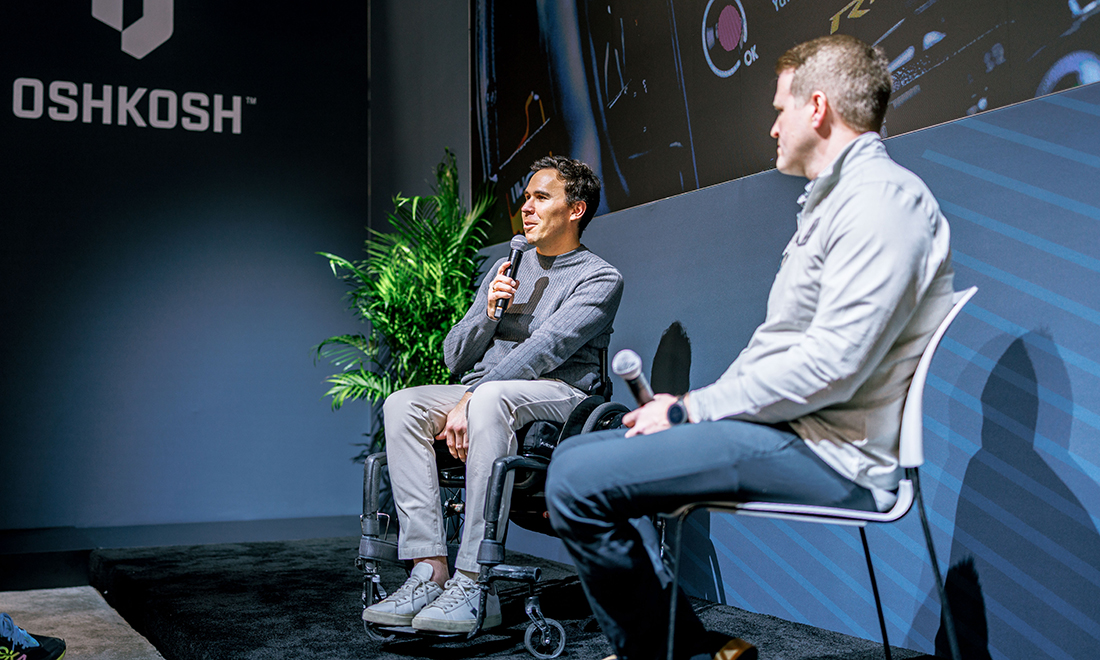
Robert Wickens sharing his story in the Oshkosh booth at CES 2025
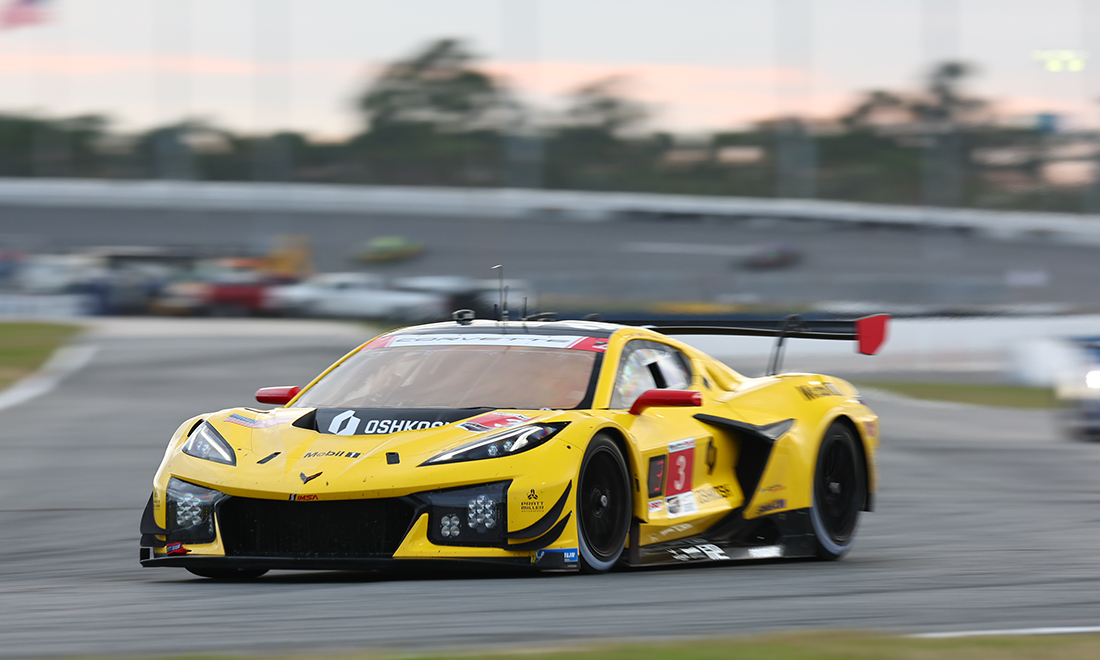
Corvette Racing by Pratt Miller Motorsports
Wickens shares the car with multiple teammates, each using pedal controls. In endurance racing, driver changes often take just 15 to 20 seconds, leaving no room for delay. Pratt Miller engineers helped develop a streamlined solution that enables drivers to switch between control methods quickly and efficiently, including the ability to transition between hand controls and pedals at the push of a button. This helps maintain performance throughout the race.
The system was refined through continuous testing and iteration to meet the demands of racing conditions. This level of innovation required collaboration across the industry. Bosch contributed advanced braking technology. General Motors supported vehicle development. Pratt Miller led integration and engineering execution. DXDT Racing brought the solution to life on the track. Together, their combined expertise turned a complex challenge into a race-ready solution.
Back on the track and competing
Wickens’ return to racing is defined by performance.
He’s already proven he can win, capturing the 2023 IMSA Michelin Pilot Challenge championship using hand controls. Today, he continues to compete at a high level, including in the IMSA WeatherTech SportsCar Championship. Technology enables performance at speed, under pressure and alongside the rest of the field.
“My goal from day zero of my recovery was to get back to the highest levels of motorsport possible and to do things that have never been achieved,” Wickens said. “For me, racing in the IMSA WeatherTech SportsCar Championship is the pinnacle of sports car racing in North America. That’s what really drove my passion to get back.”
For Wickens, the goal was never just to return. It was to compete — and to prove he could do so at the highest level.
Expanding what’s possible
While this innovation helped one driver return to racing, its impact extends further. By creating a system that can adapt to different drivers, this work establishes a path forward for accessibility in motorsports and beyond. The system was designed to be adaptable, with the potential to be integrated into other vehicles rather than remaining a one-off solution. In a space where no standard existed, it offers a foundation others can build on.
At Oshkosh Corporation, innovation is driven by the purpose to make a difference in people’s lives. Through the work of Pratt Miller and its collaborators, that commitment becomes tangible. Engineering innovation helped restore motion to a driver who lost it and, in doing so, expanded what is possible in motorsports.
“I knew with technology, with engineering, we could achieve anything we wanted,” Wickens said.
This work is not just about overcoming one challenge. It’s about opening the door for more drivers to follow. Because at its best, innovation does more than advance technology — it helps move the world forward.